Guide
Wolf oven not heating: igniter or control board?
The short answer
The quickest tell is whether anything responds. If the oven accepts settings, the display works and the igniter glows but never produces heat, suspect the igniter — it glows while drawing too little current to open the gas valve. If the display is blank, frozen, or the oven accepts a setting and nothing at all happens downstream, suspect the control board. On electric Wolf ovens there is no igniter, so a no-heat fault is the board or the element.
Why these two get confused
Both faults produce the same complaint — 'the oven won't heat' — and both are common on Wolf ovens. But they fail differently, and the difference is visible if you know what to watch for.
The igniter pattern (gas ovens)
A hot-surface igniter has to do two jobs: glow hot enough to light the gas, and draw enough current to open the gas safety valve. It loses the second ability before it loses the first. So the classic failing igniter still glows — often brightly — while the valve never opens and no gas arrives. Owners reasonably conclude the igniter is fine because they can see it working.
Other igniter signs: heating that takes far longer than it used to, ignition that eventually arrives with a thump, or a gas odor before lighting. We replaced an igniter on a Wolf oven with exactly this no-heat pattern (see the job).
The control board pattern
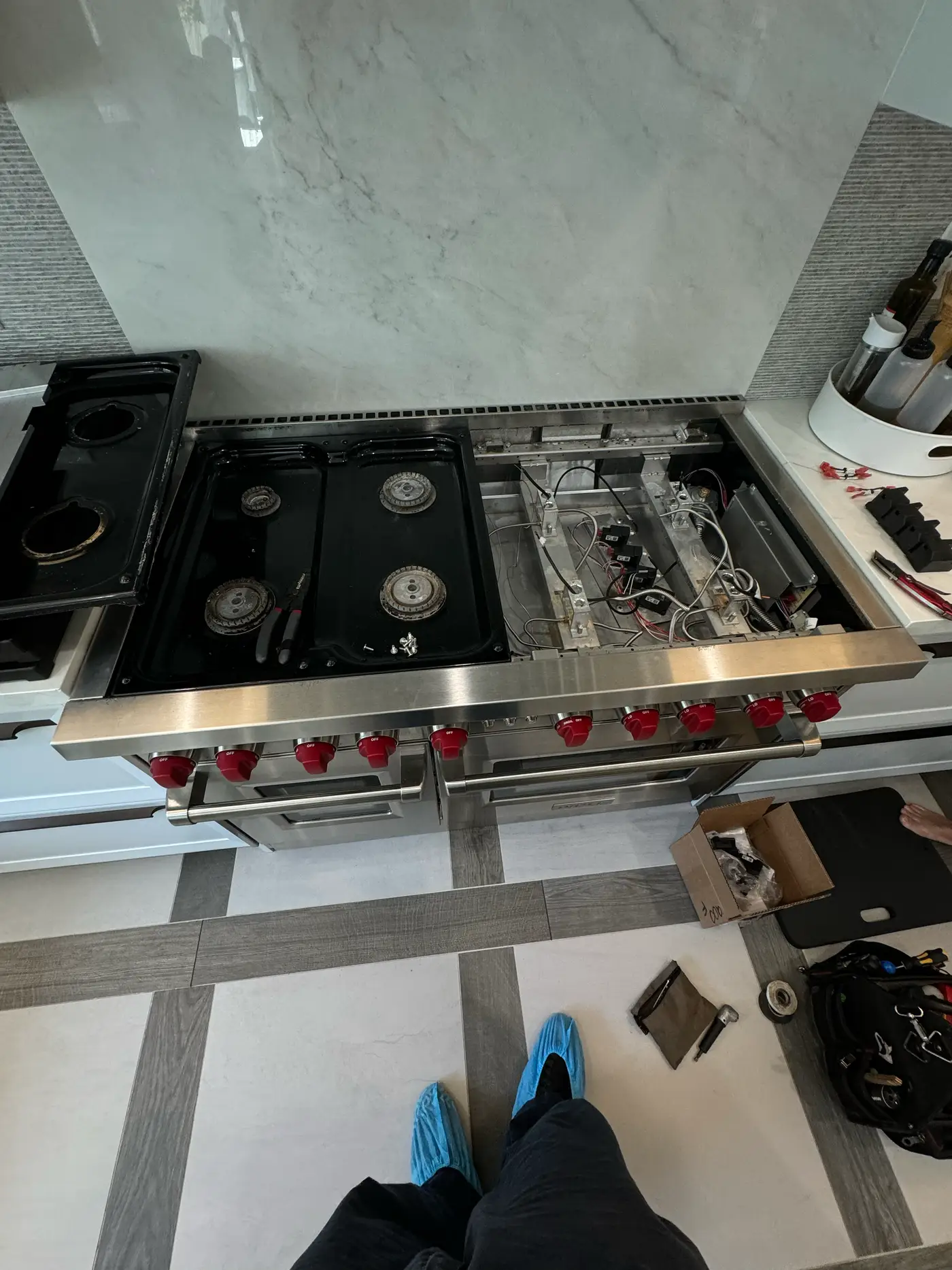
A control board failure breaks the chain earlier. The oven may accept a temperature and then do nothing at all — no igniter glow, no element, no relay click. Or the display goes blank, freezes, or the panel stops responding to touch. On a Wolf dual-oven range we traced a complete no-heat fault to the board rather than the element (that repair here); on another Wolf oven a burned board was stopping the heating element from ever activating (Manhattan Beach job).
A quick comparison
- Igniter glows, no heat → igniter (gas ovens).
- Nothing happens at all, display fine → control board, or relay board.
- Display blank, frozen or unresponsive → control board.
- One cavity of a double oven dead, the other fine → the failed cavity's own control or relay circuit.
- Slow heating, occasional gas smell → igniter, and worth prompt attention.
Why guessing is expensive
These two parts sit at very different price points, and replacing a board when the igniter was the fault means paying for the expensive answer and still owning the problem. We test the circuit before condemning either part, then quote before any work, and install OEM parts.
What you can safely check
- Confirm the oven has power and the breaker has not tripped.
- Check that the oven is not left in a lockout, Sabbath or delayed-start mode.
- On a gas oven, confirm the gas supply is on and other gas appliances work.
Nothing beyond that: igniters sit at the gas valve and boards carry line voltage. Book Wolf oven service or call (310) 361-3551 — same-day or next-day appointments across the South Bay.
See how this played out on a real job: Wolf Oven Igniter: No Heat in Torrance.
Related service: Wolf Oven and Wall Oven Repair. Reviewed by our technical team. This guide describes safe owner-level checks only; refrigerant, gas and electrical work must be left to a professional.