Guide
Why Is My Wolf Oven Not Heating?
The short answer
On a gas Wolf oven, the usual culprit is a weakened hot-surface igniter that glows but no longer draws enough current to open the gas safety valve; on an electric model, it is typically a failed heating element, temperature sensor, or control board. First confirm the breaker is on, the clock and mode settings are correct, and the door closes fully. If the oven still will not heat — or heats unevenly, slowly, or shuts itself off — leave the panels in place and schedule a diagnostic.
What the symptom looks like in practice
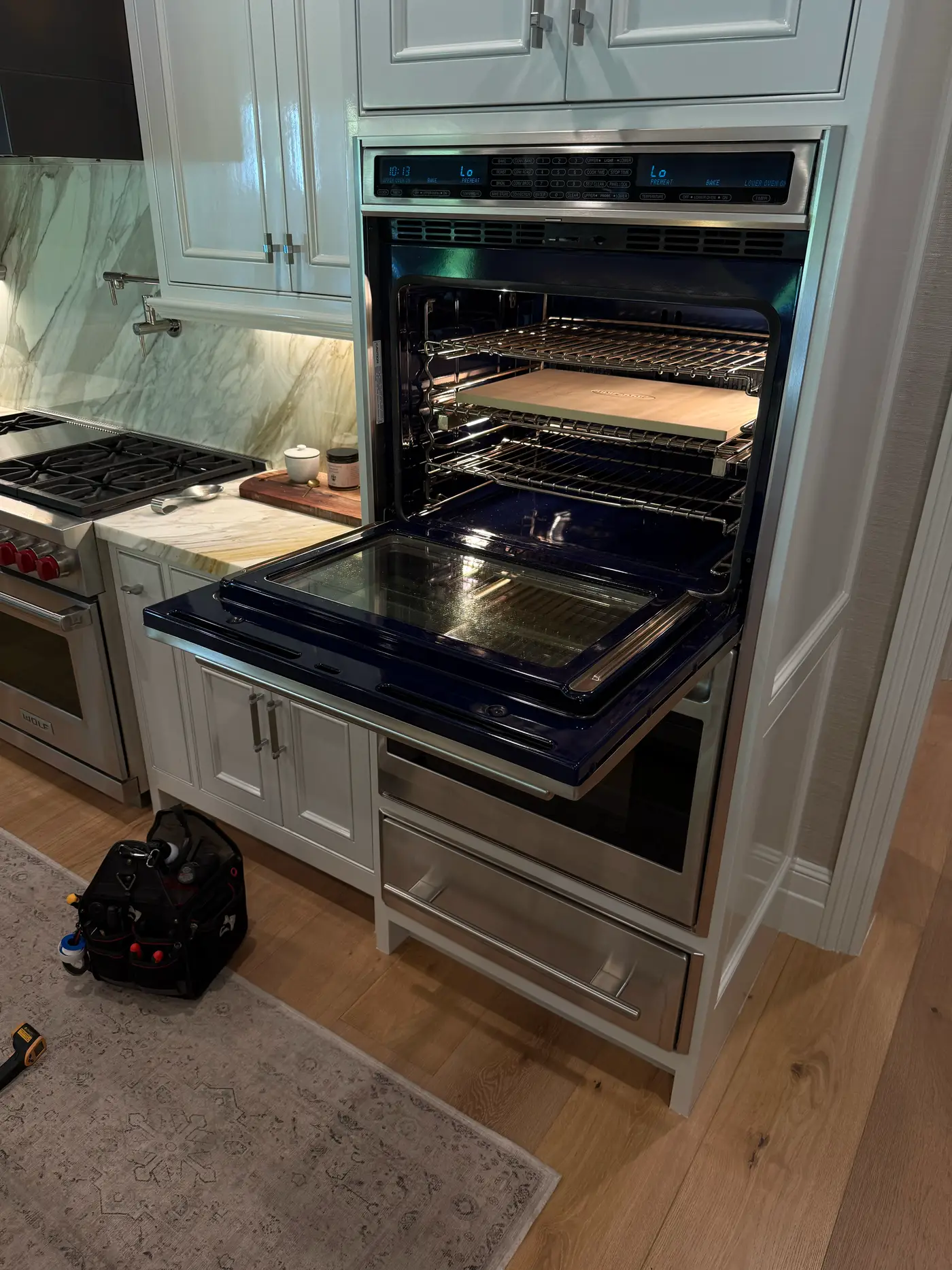
"Not heating" covers several distinct behaviors, and each points somewhere different. A gas oven may click and glow but never light, light and then go out mid-cycle, or take twenty minutes to reach a temperature it used to hit in eight. An electric oven may heat on broil but not bake, throw a fault code partway through preheat, or read hot on the display while dinner comes out raw. Note exactly what your oven does — it is the most useful thing you can tell a technician.
Likely causes, ordered by how often we actually find them
Gas models: the hot-surface igniter
Wolf gas ovens light with a hot-surface igniter wired in series with the gas safety valve. The igniter must glow hot enough to pull a specific electrical current before the valve will open — a deliberate safety design. As igniters age, they still glow orange but draw less current, so the valve stays closed or opens late. The result is slow preheat, delayed ignition, or no heat at all, often with the igniter visibly glowing the whole time. This is the most common no-heat repair on gas Wolf ovens.
Electric models: heating elements
Electric and dual-fuel wall ovens rely on bake and broil elements. When one fails, you typically lose a single function — bake works but broil does not, or the reverse — or the oven preheats at half speed because only one element is doing the work.
Control and relay boards
The control board switches power to igniters and elements through relays. A stuck or burned relay can leave an element permanently off — or, more dangerously, permanently on. Boards can also fail intermittently, which is why an oven that misbehaves "only sometimes" still deserves a proper diagnosis. Control and relay board work on Wolf ovens is a routine part of our service.
Temperature sensing problems
The oven regulates itself against a temperature sensor. When the sensor drifts, the oven may run cold, overshoot, or abort cycles. The giveaway is an oven that heats but bakes wrong: cookies pale on one rack, burned on another, or roasts that need far longer than the recipe says.
Safe checks before you call
- Breaker: verify the oven's circuit breaker is fully on — a half-tripped breaker can leave the display alive while the heating circuit is dead.
- Control panel settings: confirm the oven is not in a timed-cook, delay, or demo-style mode, and that the clock is set, since some modes will not start without it.
- Door: check that the door closes and latches flush; a door that does not fully close can interrupt heating.
- Vents: make sure oven vents and surrounding trim openings are not blocked.
- Error codes: record any code on the display exactly as shown before it clears.
Where the line is — and why
Gas ovens combine live gas, an ignition source, and line voltage in one compartment; a mis-seated igniter or a disturbed gas connection is a genuine hazard, not a learning experience. Electric models carry 240-volt circuits to the elements and boards. None of the components behind the panels can be meaningfully tested without instruments and the training to use them safely, so the owner's job ends at the checklist above.
When to stop and call
Book a visit if the safe checks change nothing, if you smell gas at any point (leave the oven off and ventilate), if the oven repeatedly shuts down mid-cycle, or if a fault code returns after clearing. An oven that heats partially is telling you a component is on its way out — catching it now is cheaper than a failure mid-holiday.
What a professional diagnostic involves
The technician measures what the eye cannot: the current an igniter actually draws, the resistance of elements and the temperature sensor, and whether the control board's relays are switching when commanded. That turns guesswork into a specific finding, and you approve the repair before work starts — no hidden fees, and a text 20 to 40 minutes before arrival so you are not waiting by the window.
Repair or replace a built-in Wolf oven?
A Wolf wall oven is sized and trimmed into custom cabinetry, so replacement means carpentry as well as cost. The platform is engineered for component-level service — igniters, elements, sensors, and boards are all replaceable — which is why repair is almost always the sensible first move on a built-in unit that is otherwise sound.
Ready when you are
With 10+ years focused on Wolf, Viking, and Sub-Zero appliances and more than 9,473 completed jobs, Wolf & Viking Service can usually see you same-day or next-day. Call (310) 361-3551 to schedule — completed repairs are backed by a 1-year warranty, with up to 2 years on select repairs.
Related service: Wolf Oven and Wall Oven Repair. Reviewed by our technical team. This guide describes safe owner-level checks only; refrigerant, gas and electrical work must be left to a professional.