Guide
Why is my Viking gas oven not heating?
The short answer
Most Viking gas ovens that stop heating have a failed hot-surface igniter: it still glows, but no longer draws enough current to open the gas safety valve, so no gas ever arrives. If nothing happens at all — no glow, no click, no response — look instead at the control board or power. Check the breaker and that the gas supply is on; everything past that is technician work.
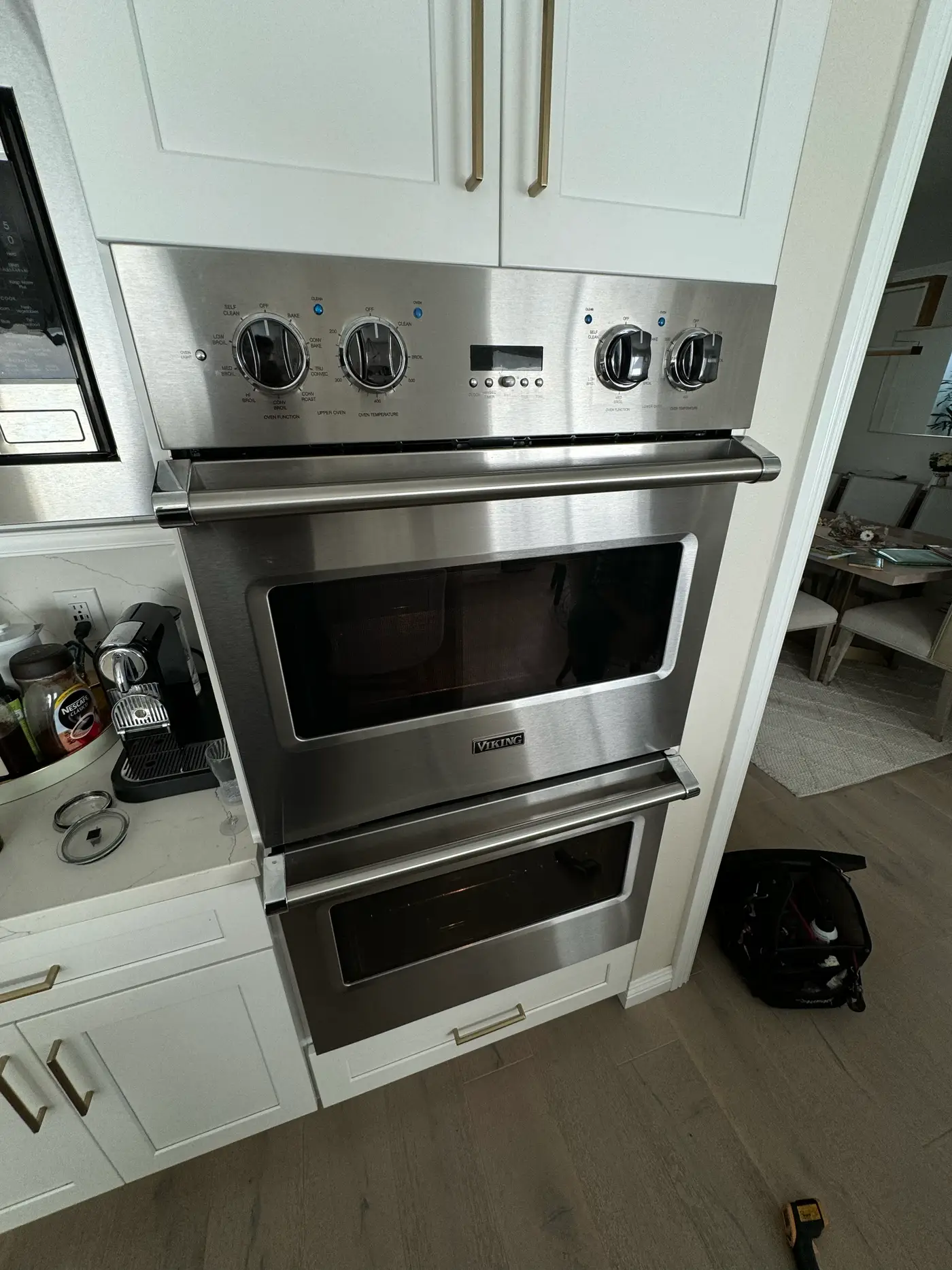
How a gas oven actually lights
Understanding the sequence makes the diagnosis obvious. You set a temperature, the control board calls for heat, the igniter begins to glow, and as it heats it draws increasing current. Only when that current reaches a threshold does the gas safety valve open — and only then does gas flow and light. Every failure below breaks that chain somewhere.
The igniter: the most common failure
Hot-surface igniters degrade slowly. They keep glowing long after they stop drawing enough current to open the valve, which is why owners so often tell us 'the igniter is fine, I can see it glowing'. The oven goes through the motions and produces no heat.
Related symptoms on the way to full failure: much longer preheat times, or ignition that eventually arrives with a noticeable thump. We replaced an oven igniter on exactly this no-heat pattern (see the job) — note that reaching a Viking oven igniter means removing the door and panels, which is why it is not a homeowner repair.
The gas supply and safety valve
If the igniter glows properly and the valve still never opens, the valve itself may have failed. First, though: is gas actually available? A supply valve left partly closed after other work, or an issue affecting the whole house, produces the same symptom for free.
The control board
When nothing at all happens — no glow, no relay click, no response to the setting — the call for heat is not being made. That is board territory rather than igniter territory. The distinction matters because these two parts sit at very different price points, which is why we test rather than guess.
The temperature sensor
A different symptom: the oven heats, but badly. Wrong temperatures, wide swings, or shutting off early usually point at the sensor reporting the cavity incorrectly rather than at the heat source.
Safe checks before you call
- Confirm the breaker has not tripped — a gas oven still needs electricity for ignition and controls.
- Confirm the gas supply is on and other gas appliances work normally.
- Check the oven is not in a lockout, Sabbath or delayed-start mode.
- Make sure the oven door closes fully; a door that will not latch stops some ovens from heating at all.
Where to stop
Igniters sit at the gas valve, boards carry line voltage, and access requires removing the door and panels. If the checks above do not restore heat, that is the end of the safe list. And if you smell gas at any point, shut off the supply if you can do so safely and call.
What our diagnostic covers
We test the ignition circuit properly — igniter current draw, valve response, board output — rather than replacing parts in sequence. You get a quote before work, OEM parts, and a 1-year warranty on completed repairs (up to 2 years on select repairs). Viking oven service · call or text (310) 361-3551.
See how this played out on a real job: Viking Oven Igniter Replacement in Santa Monica.
Related service: Viking Wall Oven Repair in the South Bay. Reviewed by our technical team. This guide describes safe owner-level checks only; refrigerant, gas and electrical work must be left to a professional.