Guide
Why Is My Sub-Zero Refrigerator Not Cooling?
The short answer
If your Sub-Zero refrigerator is not cooling, first confirm the unit has power, the controls are set correctly, and the doors are sealing fully. Then clean the condenser grille if it is accessible per your manual, since a clogged condenser is one of the most common causes. If temperatures do not recover within a few hours, stop there and schedule a diagnostic — the remaining causes involve the evaporator fan, defrost system, or sealed system, none of which are safe do-it-yourself territory.
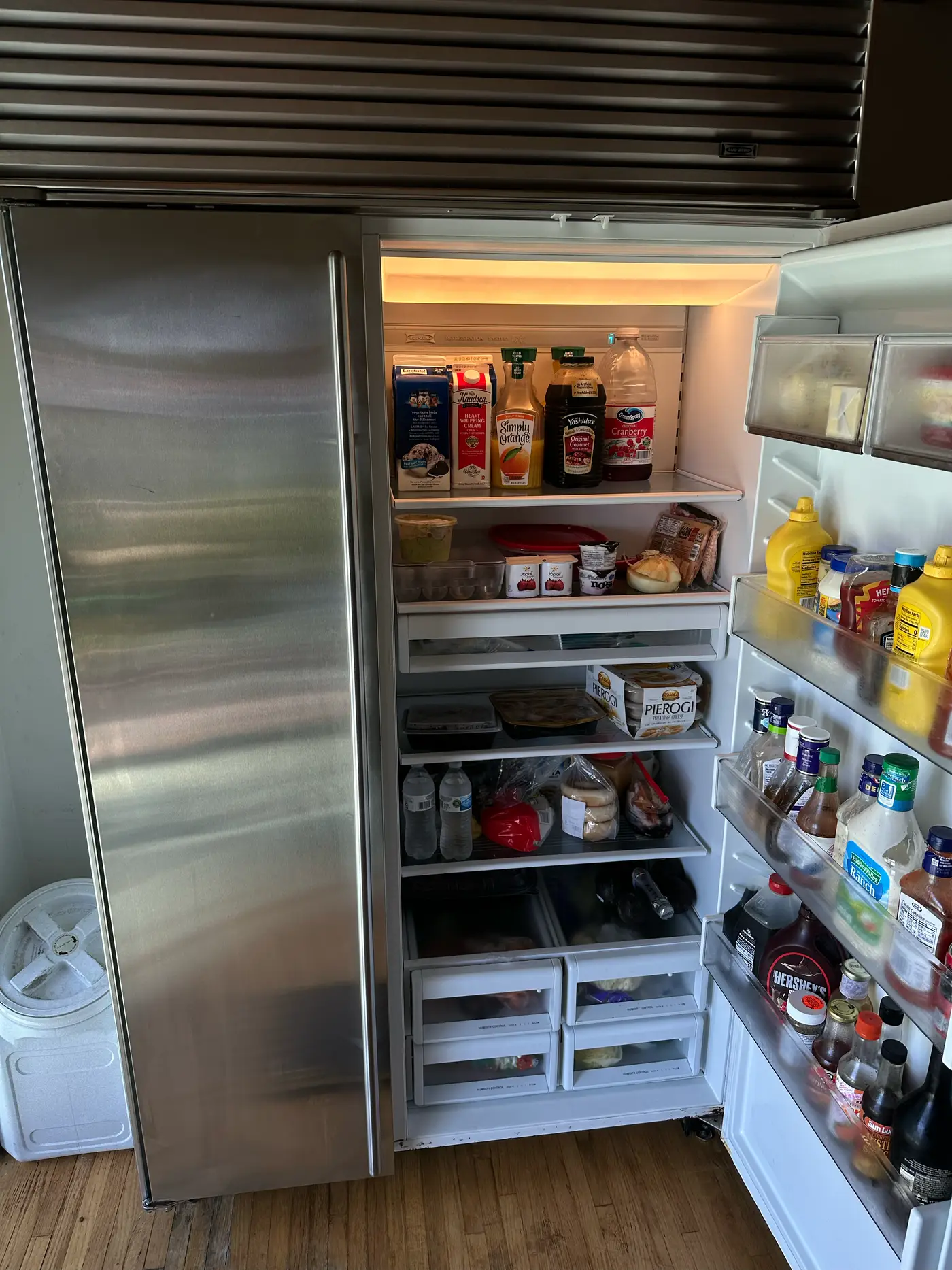
How the problem usually shows up
A Sub-Zero that is losing its cool rarely fails all at once. Owners typically notice milk spoiling early, produce wilting fast, or the display reading several degrees above the set point. Because most Sub-Zero built-ins use dual refrigeration — separate compressors and evaporators for the refrigerator and freezer compartments — it is common for one side to run warm while the other stays perfectly cold. That split behavior is actually a useful clue: it tells a technician the problem is isolated to one cooling circuit rather than something shared, like power or airflow into the unit.
You may also see a flashing Service indicator or an error code on the control panel. Write down exactly what it displays before doing anything else — that information shortens the diagnostic visit.
Realistic causes, from most to least common
- Dirty condenser. Sub-Zero units pull air through a condenser coil, usually behind the top or bottom grille. When dust, pet hair, and kitchen grease coat the coil, the system cannot shed heat and compartment temperatures creep upward. This is the single most frequent reason we find a Sub-Zero running warm, and it is preventable with routine maintenance.
- Blocked airflow or overpacked shelves. Interior vents that are covered by containers, or an exterior grille pushed tight against cabinetry, starve the unit of the air movement it needs.
- Worn or dirty door gaskets. A gasket that no longer seals lets humid room air in constantly, which both raises temperature and accelerates frost buildup on the evaporator.
- Evaporator fan failure. Each compartment relies on a fan to move air across its evaporator coil. When that fan slows or stops, the coil may be cold but the compartment stays warm. A grinding or chirping noise before the warm-up is a typical tell.
- Defrost system fault. If the automatic defrost cycle stops working, frost gradually encases the evaporator until air can no longer pass through it. Cooling declines over days or weeks rather than suddenly.
- Control board or sensor faults. A failed thermistor or control board can mis-read temperatures and run the cooling system incorrectly.
- Sealed system problems. A refrigerant leak, a failing compressor, or a restricted evaporator is the least common cause but the most serious. Because dual refrigeration gives each compartment its own circuit, a sealed system fault usually affects only one side.
Checks that are safe for you to do
- Verify the unit has power and the circuit breaker has not tripped.
- Confirm the control panel is on and set to a normal temperature — a bumped setting or an accidentally activated mode explains more warm refrigerators than you would expect.
- Close each door slowly and check that it seats fully; look at the gaskets for visible gaps, tears, or debris.
- Make sure interior vents are not blocked by food containers and the exterior grille is unobstructed.
- If your manual shows how, remove the grille and gently clean the accessible condenser surface. Sub-Zero recommends this as regular owner maintenance.
- Note any error codes or a flashing Service light — do not just clear them.
What you should not attempt, and why
Everything past the condenser grille is off-limits for good reasons. The sealed system contains refrigerant under pressure; opening it without recovery equipment is unsafe and illegal to vent. The compressor circuit and control boards carry line voltage even when the unit appears idle. And evaporator access on a built-in requires partial disassembly that is easy to get wrong and expensive to undo. If cleaning the condenser and correcting the settings does not restore normal temperatures, further probing risks turning a repairable fault into a bigger one.
When to stop and call
Call when temperatures have not recovered within a few hours of your safe checks, when only one compartment is warm, when you hear a fan or compressor noise that was not there before, or when the panel shows a Service indicator or error code. Food safety sets the clock here — a refrigerator drifting above 40°F is not a wait-and-see situation.
What a professional diagnostic involves
A technician will pull the grille and inspect the condenser, verify both compressors are starting and running, measure temperatures across each evaporator, test the evaporator and condenser fans, read the control system's stored error history, and check the defrost circuit. On dual refrigeration units this process pinpoints which circuit is at fault and whether the fix is a component swap — a fan, a sensor, a board — or sealed system work.
Repair or replace a built-in Sub-Zero?
Built-in Sub-Zero refrigerators are engineered for long service lives, and they are installed into cabinetry that was fitted around them. Replacing one often means cabinet modification on top of the cost of the unit itself, so repair is usually the sensible path — even for sealed system work — as long as the cabinet, doors, and structure of the unit are sound. A diagnostic gives you the facts to make that call rather than guessing.
Get it cooling again
Wolf & Viking Service repairs Sub-Zero refrigerators across the South Bay with same-day or next-day appointments, a text notification 20–40 minutes before your technician arrives, and no hidden fees. Completed repairs carry a 1-year warranty, with up to 2 years on select repairs. Call (310) 361-3551 or book online.
Related service: Sub-Zero Refrigerator Repair. Reviewed by our technical team. This guide describes safe owner-level checks only; refrigerant, gas and electrical work must be left to a professional.