Guide
Why Is My Viking Refrigerator Not Cooling?
The short answer
A Viking refrigerator that is not cooling usually comes down to blocked airflow at the condenser, a failed evaporator fan, a defrost problem, a control or relay board fault, or a sealed-system issue such as a refrigerant leak. Before anything else, confirm the unit has power, the controls are set to a normal temperature, and the door is closing fully. If those check out and the cabinet is still warm after a few hours, stop there and book a diagnostic — the remaining causes are not owner-serviceable.
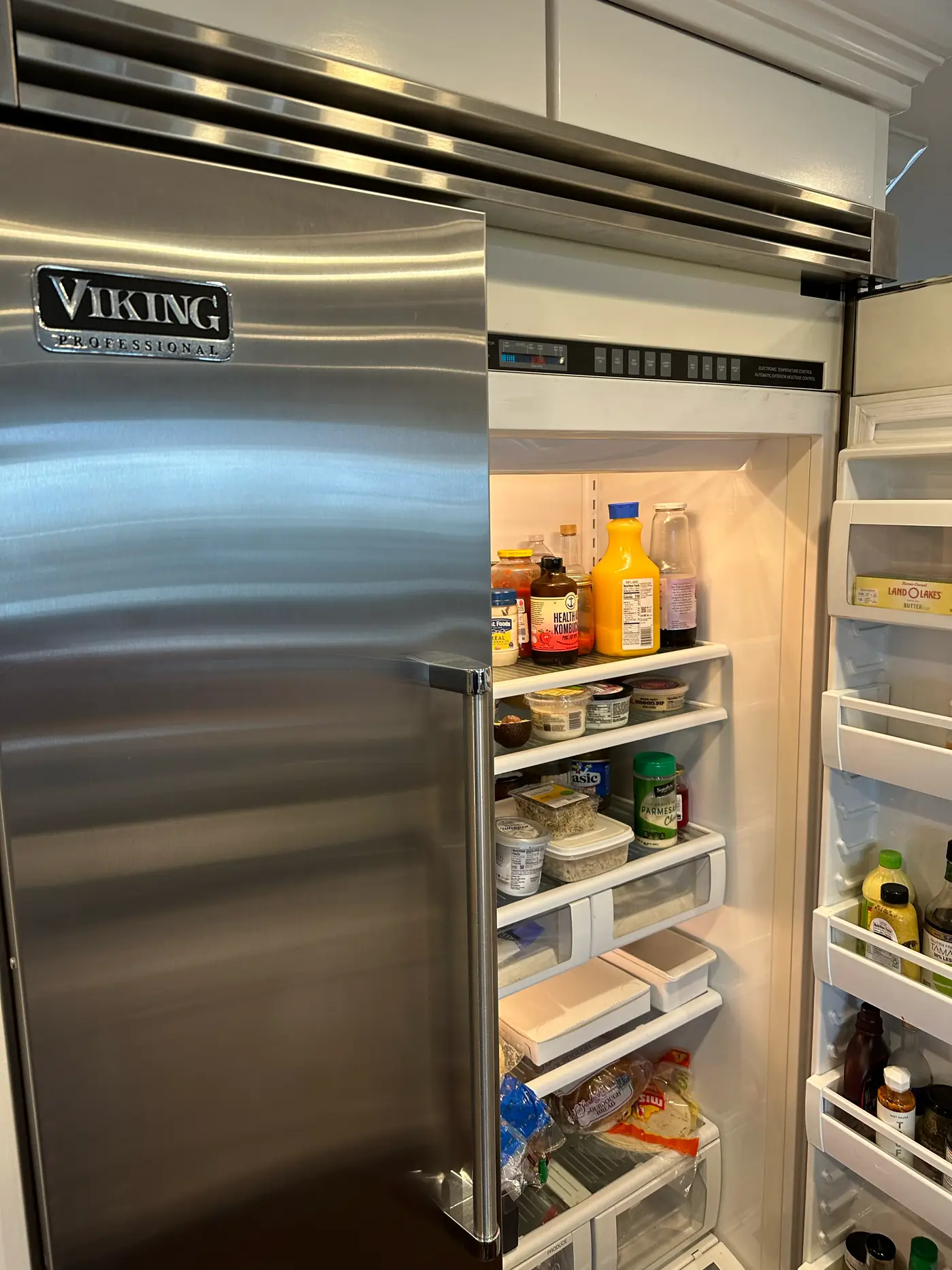
How the problem usually shows up
Warm milk is rarely the first sign. Most owners notice the refrigerator running longer than usual, food spoiling faster on certain shelves, condensation inside the cabinet, or the compressor cycling constantly without ever reaching temperature. Sometimes the freezer stays cold while the fresh-food side drifts warm; sometimes the whole unit slowly loses ground over several days. The pattern matters, because each cause leaves a different fingerprint.
The realistic causes, from most to least common
Blocked airflow at the condenser
Built-in Viking refrigerators reject heat through a condenser that sits behind a grille. When dust, pet hair, or kitchen grease coats it — or when the grille itself is obstructed — the system cannot shed heat, pressures climb, and cooling capacity falls off. This is the single most common reason a unit that worked fine for years gradually stops keeping up.
Evaporator fan failure
Cold is made at the evaporator, but a fan has to move that cold air through the compartment. When the fan motor wears out or ices up, the evaporator can be freezing cold while the shelves stay warm. A telltale sign is a unit that sounds quieter than usual, or one that hums and clicks without the familiar airflow noise.
Defrost system problems
The evaporator coil defrosts itself on a schedule. If that cycle fails, frost slowly encases the coil until air can no longer pass through it. Owners often describe this as a refrigerator that gets worse over one to two weeks, then briefly improves after being unplugged — because the frost melted.
Control or relay board faults
Viking refrigeration relies on electronic boards to switch the compressor, fans, and defrost components. A failing relay or control board can keep the compressor from starting, run it erratically, or ignore the thermostat entirely. Symptoms are often intermittent: the unit cools normally for days, then stalls. Board-level diagnosis and replacement is standard work for us on Viking refrigerators.
Sealed-system failure
Least common but most serious: a refrigerant leak, a restriction, or a failing compressor inside the sealed system. The classic signature is a compressor that runs constantly while the cabinet never gets cold, or an evaporator that frosts only in one small patch. Sealed-system work requires refrigerant recovery, brazing, and recharging to specification — this is a shop-grade repair, and it is one of our core specialties on Viking units.
What you can safely check yourself
- Power and breaker: confirm the circuit breaker has not tripped and the unit shows signs of life (lights, display).
- Control settings: make sure the temperature setpoint was not changed and the unit is not in a display or vacation-type mode.
- Door closure and seals: check that nothing is propping the door open and the gasket seals flat all the way around.
- Grilles and vents: confirm interior vents are not blocked by food containers and the exterior grille has open airflow.
- Condenser grille: if your model's manual shows an accessible condenser grille, cleaning it per the manual is safe and often helps.
- Error codes: if the display shows a code, write it down exactly — it shortens the diagnostic.
What is not safe to attempt
Everything beyond the list above involves real hazards. The sealed system contains pressurized refrigerant that legally and practically requires recovery equipment. The compressor circuit carries line voltage and components that store charge even when the unit is unplugged. Digging into the evaporator compartment to chip out frost can puncture the coil and turn a defrost fix into a sealed-system repair. If a check requires a screwdriver, it is not an owner check.
When to stop and call
Call when the safe checks are done and the cabinet is still not holding temperature, when the compressor runs nonstop, when you hear clicking or buzzing at startup, or when a fault code appears. Food safety sets the clock: a refrigerator drifting above safe temperature is a same-day problem, and we hold same-day and next-day appointments for exactly this reason.
What a professional diagnostic involves
A technician will verify airflow and fan operation, read the control board's behavior against the thermostat inputs, measure compressor operation, and check evaporator frost patterns — which reveal whether the fault is electrical, defrost-related, or inside the sealed system. You get a clear finding and a repair plan before any work begins, with no hidden fees, and a text notification 20 to 40 minutes before the technician arrives.
Repair or replace a built-in Viking?
Built-in refrigerators are part of the cabinetry, and swapping one is a renovation-scale project, not an appliance purchase. Because the platform is built to be serviced — boards, fans, and even sealed-system components are repairable — a proper repair usually restores years of service for a fraction of the disruption of replacement. Replacement only starts to make sense when a unit has multiple major failures at once.
Get it cooling again
Wolf & Viking Service has spent more than 10 years on Viking, Sub-Zero, and Wolf appliances, with over 9,473 completed jobs behind us. Call (310) 361-3551 to book a same-day or next-day appointment — every completed repair carries a 1-year warranty, and select repairs are covered for up to 2 years.
See how this played out on a real job: Viking Control-Board Replacement in Arcadia.
Related service: Viking Refrigerator Repair in the South Bay. Reviewed by our technical team. This guide describes safe owner-level checks only; refrigerant, gas and electrical work must be left to a professional.